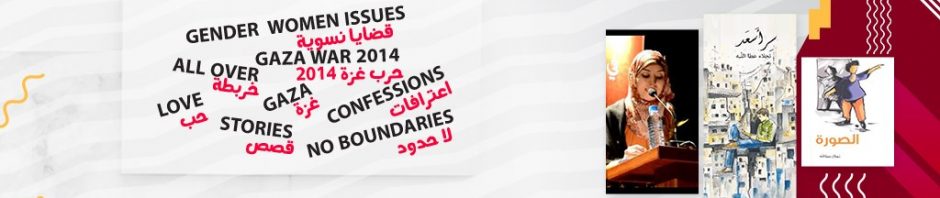
Najlaa Attaallah, Edited by Ra Page
‘Where do you see yourself in ten years time?’ he asked confidently.
To this day, the look on his face – before and after I answered him – have stayed with me. This question was one of my favourite interview questions; it was like a key to a secret garden. With it, I could be like Alice in the Wonderland, or like a noble warrior with two weapons in her hands: faith and desire. With these two weapons, I was able to answer the question positively. Although my response was unpredictable, maybe even inappropriate, several of the panellists sitting in front of me gasped.
Like all the other questions, it was designed to measure the ambition of the candidates, to see if they were suitable for a senior position in one of few the NGOs working in Gaza. I was 25 years old, and I had energy and youth on my side. At that age I believed anything was possible, and managed to ignore the many problems wrapping Gaza’s neck like a snake. I used to repeat the slogan, ‘I’m in Gaza, yes I can.’ This was between the 2008 war and the 2011/12 one. Later in 2013, UNRWA released a report titled ‘Gaza in 2020’ in which it forecasted that, by 2020, Gaza would be unliveable. Ever since that report, the situation in Gaza has become progressively worse, in every aspect. Despite these worsening conditions, I never gave up, and continued to dream. But in February 2018, all that changed. I`m 30 now, with a family, two kids. I can no longer afford to worry about my dream. Instead, I have to look to my children and answer their questions about Gaza’s future (not mine). Will my partner and I be able to provide them with the basics to survive: clean water, food, access to healthcare? Will we ever be able to promise them more than a few hours of electricity a day?
My husband and I work fulltime, but both of us on temporary contracts. We’ve been able to make the first step, at least, in providing for our children: a house. And we count our blessings for this much. But every night we go to bed not knowing if tomorrow we will be fired; each night we lie awake imagining scenarios in which we’re all evicted because we can’t pay back loans.
In January, the US announced it was cutting its funding for UNRWA, the organisation I work for, and since then the whole of Strip has been preparing for the worst. The people of the Strip are willing to protest, to fight if necessary, even to sacrifice themselves if needs be for the rights of their fellow Palestinians. They have been repeating the slogan ‘I’m in Gaza, yes I can.’ And with 43.9 % of Gazans currently unemployed, according to Palestinian Central Bureau of Statistics (many of them young people), you realise that many of them have nothing to lose.
Young people in Gaza are hanging by a thread, swinging between hope and despair. Maybe the protests will bring about the end to the asphyxiating, 11-year siege imposed on Gaza since 2007. Then again, maybe it won’t.
Despite my convictions and my self-belief, I can’t be the same person I was ten years ago. Although I cannot forget the interview panellists’ reactions to my answers all those years ago; I have, it seems, forgotten the dreams I had, the ambitions. On 30 March, the people of Gaza commemorated ‘Land Day’ (the day in 1976 when 6 Palestinian were killed defending a piece of their land by the Israeli soldiers). Now the Great March of Return has become an event for the calendar. Thousands of people walked out towards the eastern borders, with the intention of expressing peacefully a desire to return once more to lands that had been snatched from them in 1948. I asked relatives, friends, and all the people in my neighbourhood: why you are joining this march? What’s the point?
Most of them just gave me a tired look and the half-response ‘Because I can’. It didn’t take long for me to realise this all we have; this is the only way to tell our story; with our feet, with our voices; with our bodies. Gaza has been under siege for 11 years; the economic situation is beyond bad; Palestinians are desperate; young people need a light at the end of this tunnel; they need something. So we fill our throats, and raise our voices. We hit the air with our fists, though we pray each Friday for a peaceful day. We take ourselves to buffer zone, to the danger zone lined with sand-dunes, and barbed-wire, and snipers waiting to kill us. Because we are in Gaza, yes we can. Yes, it is our right to return, it is our right to live.

 Najlaa
 Najlaa`s blog